
If We Win, This Changes Everything
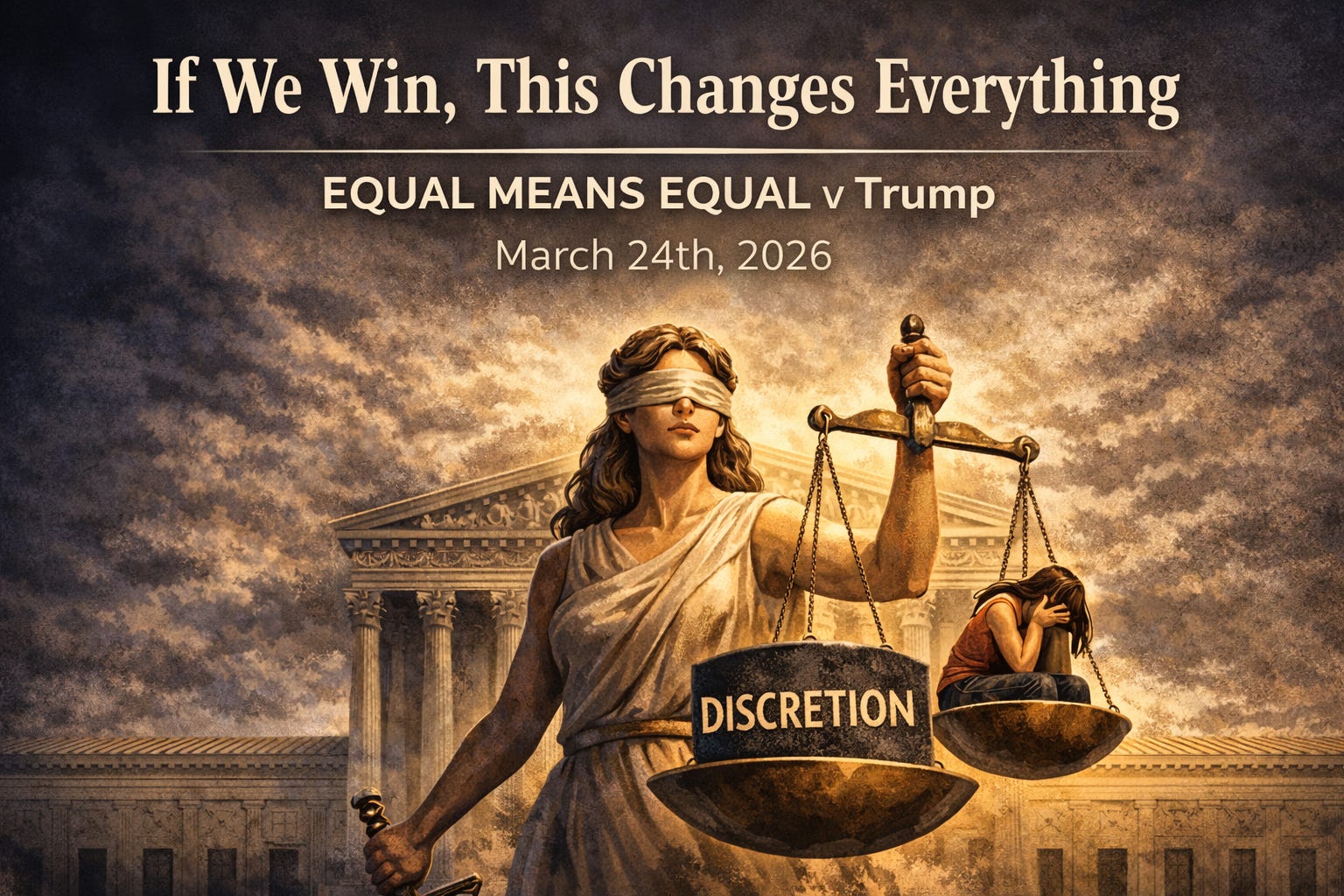
On March 24, a federal court will confront whether violence against women is treated as a civil rights violation — or left to rhetoric.

When Girls Report — and Nothing Happens
In 1996, Maria Farmer went to the police.
She reported sexual abuse. She named Jeffrey Epstein. She described what had happened to her inside his Manhattan townhouse and at his Ohio property.
She was told the matter involved federal crimes and that she should report it to the FBI.
So she did.
She met with federal agents. She gave a detailed account. She provided names, locations, and descriptions. She followed the rules.
Nothing happened.
Not weeks later.
Not months later.
Not in any way that stopped him.
Years later, her younger sister Annie — who had been abused as a teenager at Epstein’s New Mexico ranch — also came forward. When the scope of Epstein’s conduct became clearer, she reported what had happened to her.
Again, nothing happened that prevented continued abuse.
In the years that followed, Epstein went on to exploit girls on a scale that now appears staggering — dozens, then hundreds, possibly more than a thousand.
This was not a single failure.
It was sustained non-enforcement.
Corruption — or Structure?
Many believe powerful men protected one another.
There is evidence that influence distorted accountability.
But corruption alone does not explain duration.
Sustained inaction requires something more stable than conspiracy.
It requires a structure that does not demand urgency.
Sex-based harm in the United States is widespread.
It is not rare.
It is not aberrational.
And because it is treated as ordinary, it does not trigger the Constitution’s highest protection.
Inaction carries no elevated burden.
Delay carries no automatic consequence.
Redirection becomes administrative.
That is architecture.
The Lawsuit We Filed
EQUAL MEANS EQUAL filed a federal lawsuit now before the United States District Court in Massachusetts.
The case — EQUAL MEANS EQUAL v. Trump — asks a direct question:
Must the Equal Rights Amendment, having met the constitutional requirements for ratification, be recognized and enforced as part of the Constitution?
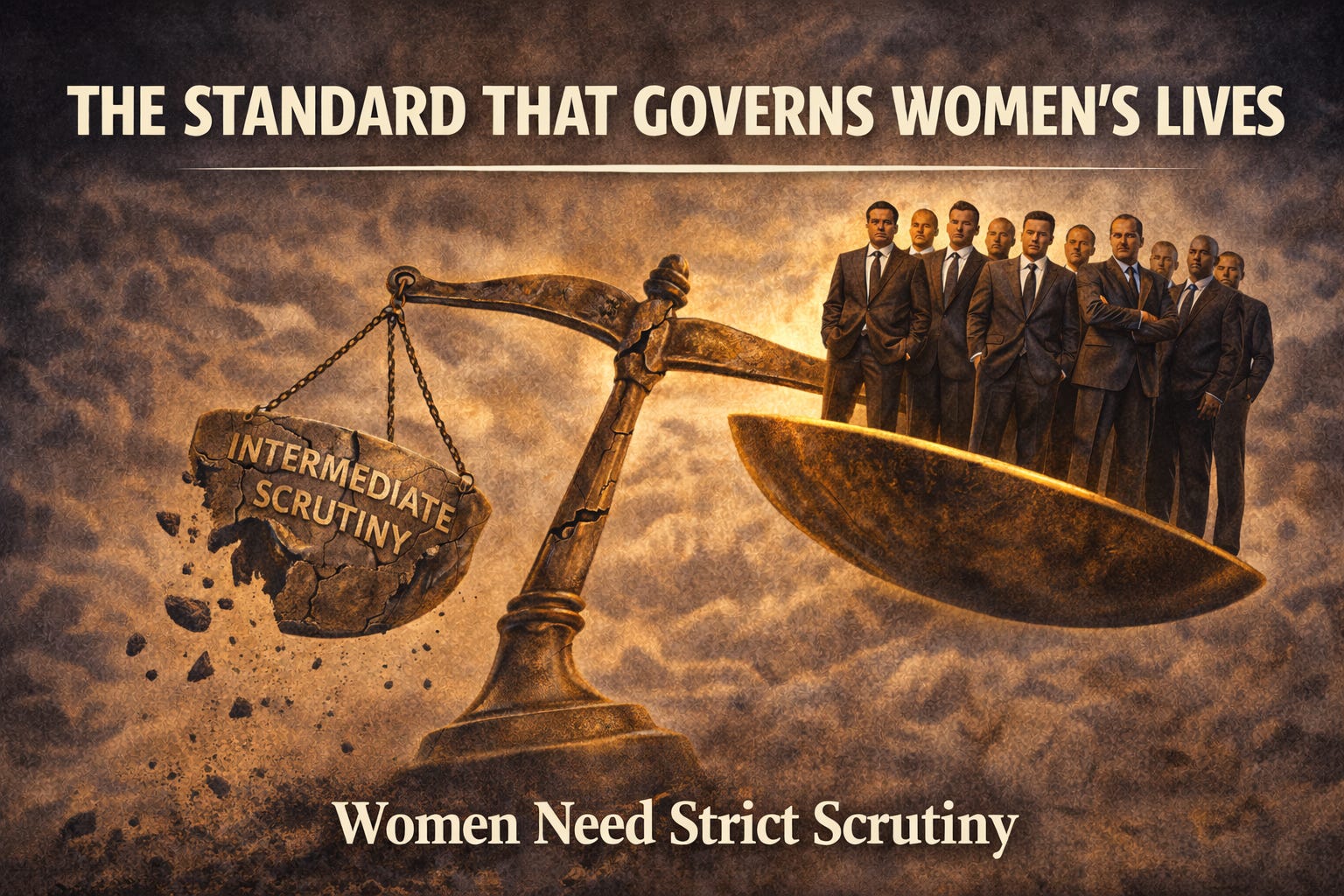
If recognized, sex discrimination would no longer receive intermediate scrutiny.
It would receive strict scrutiny — the highest level of constitutional review.
This is not symbolic recognition.
It concerns the constitutional standard that governs how seriously the state must treat sex-based harm.
The Standard That Governs Women’s Lives
Under current Supreme Court doctrine, sex discrimination receives intermediate scrutiny.
The government must show its action is substantially related to an important interest.
That standard allows latitude.
Prosecutors cite resource constraints.
Police reinterpret mandatory enforcement as discretionary.
Family courts reframe abuse as conflict.
Employers mask retaliation as restructuring.
Even when patterns of discrimination are widespread — even when statistics show systemic disparities — courts often require narrow, individualized proof. Structural inequality is broken into pieces. Each piece is evaluated separately. The larger pattern becomes harder to confront.
Sex-based harm is common. It is predictable. It is embedded across systems.
But it is not treated as constitutionally urgent.
And that determines response.
What Strict Scrutiny Does
Strict scrutiny shifts the burden.
The state must show a compelling interest.
Patterns matter.
Disproportionate non-enforcement matters.
When harm falls overwhelmingly on women — what civil rights law calls “disparate impact” — it becomes harder to dismiss as coincidence.
Systemic disregard becomes reviewable.
No constitutional standard eliminates predators.
But standards shape incentives.
When failure to protect women and girls carries constitutional risk, institutions respond differently.
Return to the Farmer sisters.
When a young woman reports sexual abuse and is redirected — and nothing happens — that silence is labeled discretion.
Under strict scrutiny, systemic failure to act becomes far harder to defend as ordinary judgment.
The same applies elsewhere:
When restraining orders are violated without enforcement.
When mothers lose custody after reporting abuse.
When prosecutors routinely decline intimate partner violence cases.
When workplace retaliation follows harassment complaints.
These patterns accumulate.
They teach victims that reporting changes nothing.
They teach institutions that delay carries no penalty.
They teach perpetrators that risk is low.
Strict scrutiny changes cost.
Cost changes behavior.
If the Equal Rights Amendment is enforceable, the Constitution will require the government to treat violence and discrimination against women as a civil rights violation — not a policy preference.
Why This Moment Is Different
For decades, the debate over the Equal Rights Amendment has revolved around deadlines, congressional resolutions, and political positioning.
This moment is different.
A federal court is being asked to decide enforceability.
Not symbolic recognition.
Not public support.
Enforceability.
If the court recognizes the Equal Rights Amendment as binding constitutional law, sex discrimination moves from second-tier review to the highest level of scrutiny.
The argument shifts from “should women be equal?” to “how will equality be enforced?”
That shift is no longer theoretical.
It is before the court.
What Happens Next
On March 24 at 2 p.m. Eastern, the United States District Court in Massachusetts will hear arguments in EQUAL MEANS EQUAL v. Trump.
The question before the court is direct:
Will sex discrimination continue to receive lesser constitutional protection — or not?
This is not a symbolic hearing.
It concerns the standard that governs how seriously the state must treat sex-based harm.
Standards are not abstractions.
They determine whether institutions respond swiftly or defer.
Whether delay carries consequence.
Whether patterns of non-enforcement are tolerated or scrutinized.
The next woman who reports abuse will not know the phrase “strict scrutiny.”
She will know whether someone acted.
That is what this case addresses.
If the Equal Rights Amendment is enforced, the constitutional architecture governing women’s lives shifts.
That is doctrine.
And doctrine shapes reality.
Those who believe women deserve full constitutional protection should pay attention to this moment.
This is where enforceability is tested.
So incredibly well said! Our enemies across the political spectrum are arrayed against us, covering up for and excusing harms against women. This is a watershed moment.
Can anyone comment on how they can actually make this worse for us if we do not actually receive equality or if it is appealled to the Supreme Court? I don't have any confidence in Supreme Court majority.