

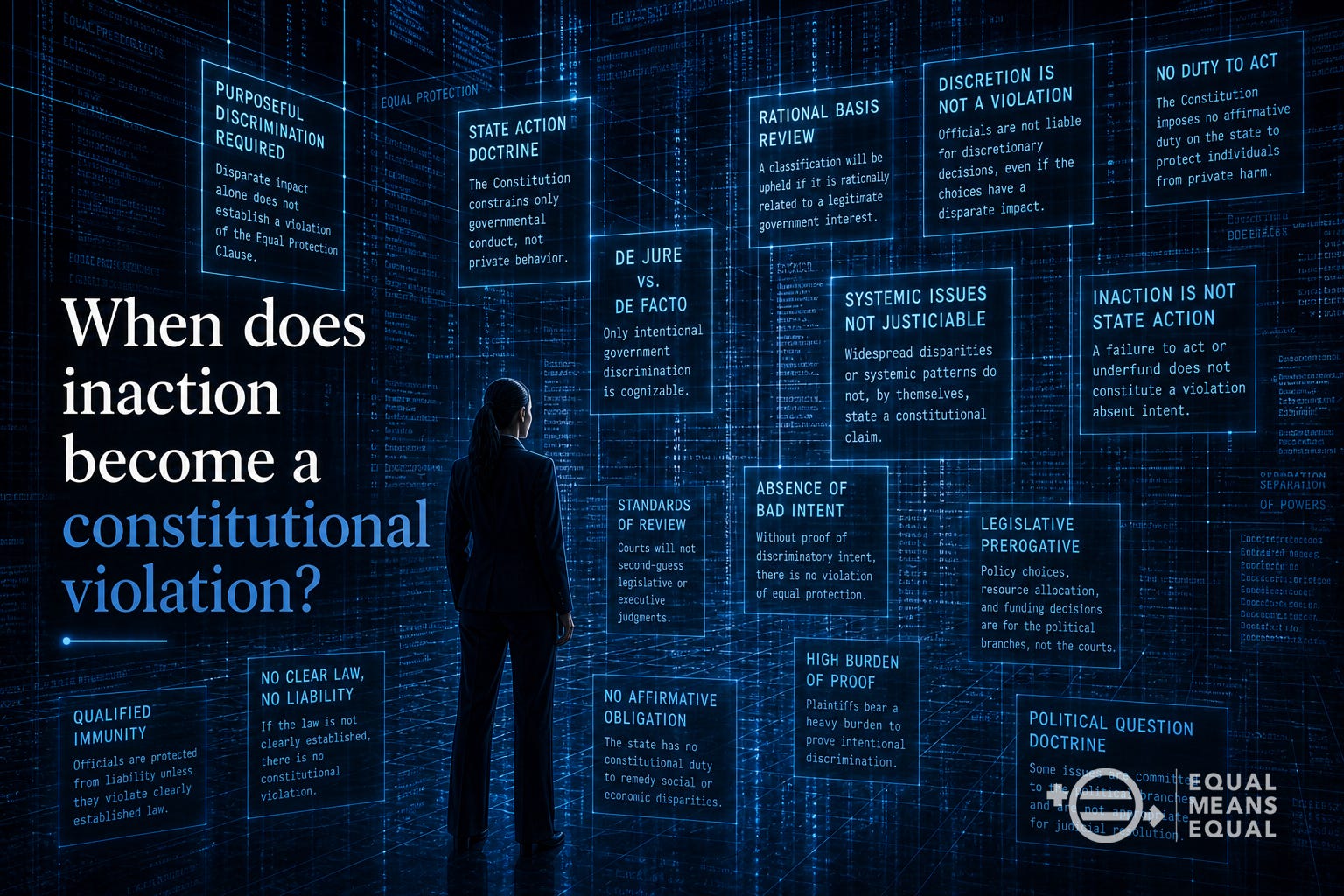
What Women Already Know
Women are often told the system failed accidentally.
This essay argues that the failure is structural — and that women have been trapped inside that unequal structure for a very long time.
If you ask most women whether the legal system protects them, you won’t get a theoretical answer.
You’ll hear about restraining orders that were ignored. Assaults where the evidence was clear but meaningful consequences never followed. Cases where the facts were established, the harm was real, and yet the burden shifted back onto the person who was harmed.
We saw it in Town of Castle Rock v. Gonzales, when Jessica Gonzales repeatedly begged police to enforce a restraining order against her estranged husband before he murdered their three daughters. The Supreme Court ultimately ruled that enforcement of the order was not guaranteed.
We saw it in United States v. Morrison, after Virginia Tech student Christy Brzonkala reported that she had been gang raped by two football players. Congress later compiled extensive evidence showing that women facing gender-based violence were routinely failed by state systems. It created a federal civil rights remedy intended to address that failure. The Supreme Court struck the remedy down.”
Again and again, the pattern is the same: harm is recognized, but enforcement disappears.
These were not subtle moments.
They were national shocks.
And then the system absorbed them.
No structural correction followed.
No meaningful legal shift occurred.
No mechanism was created that required the system to respond differently the next time.
That is the pattern.
Recognition happens.
Public outrage erupts.
And then the structure reasserts itself.
For decades, women have been told to trust the system because the law recognizes discrimination, recognizes violence, recognizes harm.
But recognition is not the same as enforcement.
And a right that cannot be enforced does not function as a right.
Women have lived with this contradiction for a very long time. It is time to confront it directly: either women are guaranteed the equal protection of the laws under the Constitution, or we are not.
The Rule Beneath the Pattern
What makes this pattern difficult to confront is that it does not come from a single failure.
It comes from a rule.
Across multiple cases, the Court has drawn a line defining when the Constitution requires action — and when it does not. That line does not turn on harm. It does not turn on knowledge. And it does not turn on whether the outcome could have been prevented.
It turns on whether the state is understood to have acted — or simply failed to intervene.
In DeShaney v. Winnebago County, state officials knew that a young child was being repeatedly abused by his father. They had been warned. They had intervened before. They had evidence of escalating harm.
They did not remove him.
The abuse continued until the child suffered permanent brain damage.
The question before the Court was not whether the harm was real. It was not whether the state could have intervened. It was whether the Constitution required it to do so.
The Court said no.
Because the state had not created the danger, its failure to act did not violate the Constitution. Knowledge was not enough. Preventability was not enough. Even repeated contact with the case was not enough.
The distinction held: action triggers responsibility. Inaction does not.
That same framework appeared again in Town of Castle Rock v. Gonzales.
Jessica Gonzales had a restraining order against her estranged husband. After he abducted their children, she repeatedly contacted police asking them to enforce it.
They did not.
The children were later found dead.
The central constitutional question was not whether the danger had been foreseeable. It was whether the failure to enforce the order violated a protected constitutional right.
The Court said no.
Even where the law appears to mandate protection, enforcement remains discretionary. A legal protection can exist on paper without creating a constitutional obligation to carry it out.
In United States v. Morrison, the Court confronted a different dimension of the same structure.
After Virginia Tech student Christy Brzonkala reported that she had been gang raped by two football players, Congress compiled extensive evidence showing that women subjected to gender-based violence were routinely failed by state systems and created a federal civil rights remedy intended to address that failure.
The Court struck it down.
Not because the violence was unclear.
Not because the pattern was disputed.
But because the harm was ultimately framed as private — beyond the scope of constitutional enforcement.
Across these cases, a consistent structure emerges.
The Constitution does not require the state to protect individuals from harm.
It does not require enforcement of laws designed to provide that protection.
And it does not recognize gender-based violence, on its own, as a constitutional violation.
This is not a legal gap.
It is a constitutional framework.
One in which harm can be known, anticipated, documented, and repeatedly ignored — without triggering a constitutional obligation to act.
When Discrimination Still Doesn’t Count
That structure does not only appear in cases involving violence.
It also appears in how the law understands discrimination itself.
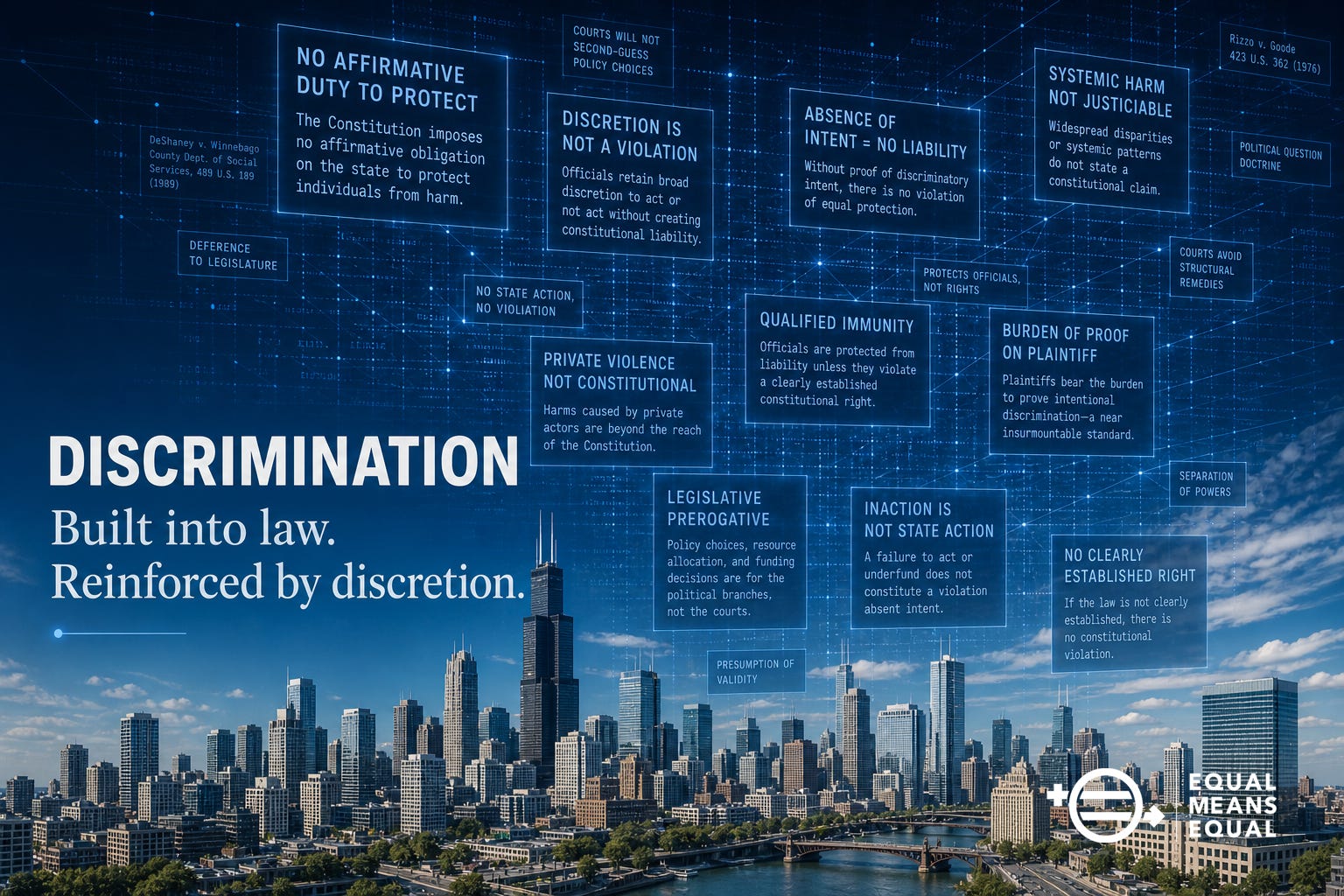
In Personnel Administrator v. Feeney the Court considered a Massachusetts law that gave an absolute hiring preference to veterans for civil service jobs.
On its face, the law did not mention sex.
In practice, it overwhelmingly favored men.
At the time, women had been largely excluded from military service. The result was predictable: a system that rewarded veterans would systematically advantage men over women in public employment.
The impact was clear. It was measurable. It was not in dispute.
And the Court acknowledged it.
But that was not enough.
The Court held that the law did not violate the Constitution because it was not enacted because of its impact on women, only in spite of it.
That distinction carried enormous weight.
It meant that a law could be built on a structure that excluded women, could produce ongoing disadvantage for women, and could be fully understood to do so—and still be upheld.
So long as the stated purpose was something else.
The result is a system that can recognize inequality, trace its effects, and still decline to treat it as discrimination.
This matters now in a way it did not when Feeney was decided.
Because the same underlying structure—the use of military service as a neutral benchmark—remains embedded in federal law.
In the case we are now litigating, EQUAL MEANS EQUAL v Trump, the federal government is being asked to explain why a system built on sex-based classification in military service can continue to exist under the Constitution.
The question is not abstract.
It is whether a framework that has historically excluded women can still be used to justify legal distinctions that affect them.
And, more directly, whether the Constitution requires the government to correct that structure—or permits it to leave it in place.
When Even Proof Is Not Enough
That logic does not apply only to women.
It defines how the system responds to discrimination more broadly.
In McCleskey v. Kemp the Court was presented with one of the most comprehensive statistical studies ever introduced in a criminal case.
The study examined death penalty sentencing in Georgia and found a consistent pattern: defendants accused of killing white victims were far more likely to receive the death penalty than those accused of killing Black victims. Black defendants, particularly those accused of killing white victims, faced the highest likelihood of being sentenced to death.
The disparity was not anecdotal. It was systemic. It was measurable. It was documented across hundreds of cases.
And the Court did not dispute it.
Instead, the Court held that this evidence was not enough.
To establish a constitutional violation, the defendant would have to prove that the decision-makers in his specific case acted with discriminatory intent.
Systemic evidence was not sufficient. Statistical proof was not sufficient. Even a pattern that revealed how the system functioned in practice was not sufficient.
The burden remained individualized.
The implication was clear.
A system could produce unequal outcomes, repeatedly and predictably, and still be treated as constitutionally valid—so long as discrimination could not be proven in the narrowest possible frame.
In other words, the Court was willing to acknowledge the pattern, but not to act on it.
When Harm Is Redefined
That same structure appears again in how the law treats women’s bodily autonomy.
In Bray v. Alexandria Women’s Health Clinic the Court was asked to decide whether coordinated efforts to block access to abortion clinics could be treated as a form of discrimination against women.
The facts were not abstract.
Organized groups physically obstructed clinic entrances, preventing women from obtaining medical care. The impact was immediate and direct. Women seeking abortions were the ones turned away. Women were the ones forced to carry pregnancies they had chosen to end.
The targeting was clear.
And the Court acknowledged the conduct.
But it drew a distinction.
Opposition to abortion, the Court held, was not necessarily the same as discrimination against women as a class. The harm could be understood as directed at a procedure, not at the people who require it.
That distinction did the work.
By separating the act from the class it affects, the Court was able to recognize the impact without treating it as a constitutional violation.
The result is a framework in which a policy can operate entirely on women’s bodies, restrict women’s autonomy, and reshape the conditions of women’s lives—and still be understood, legally, as something other than discrimination against women.
Happening Now
That framework is not theoretical.
It is being applied now.
Across the country, access to medication abortion—the most common method of ending a pregnancy in the United States—is being restricted through a combination of state bans, federal litigation, and regulatory pressure.
The mechanism is familiar.
The restrictions are framed as concerns about safety, procedure, or jurisdiction. They are described in neutral terms. They are debated as questions of policy.
But the impact is not neutral.
The burden falls on women—on their bodies, their timelines, their autonomy, and their ability to make decisions about their own lives.
And once again, the legal question is not whether that impact exists.
It is whether the system is required to treat that impact as discrimination—or whether it can recognize the harm and still decline to act.
The Indictment
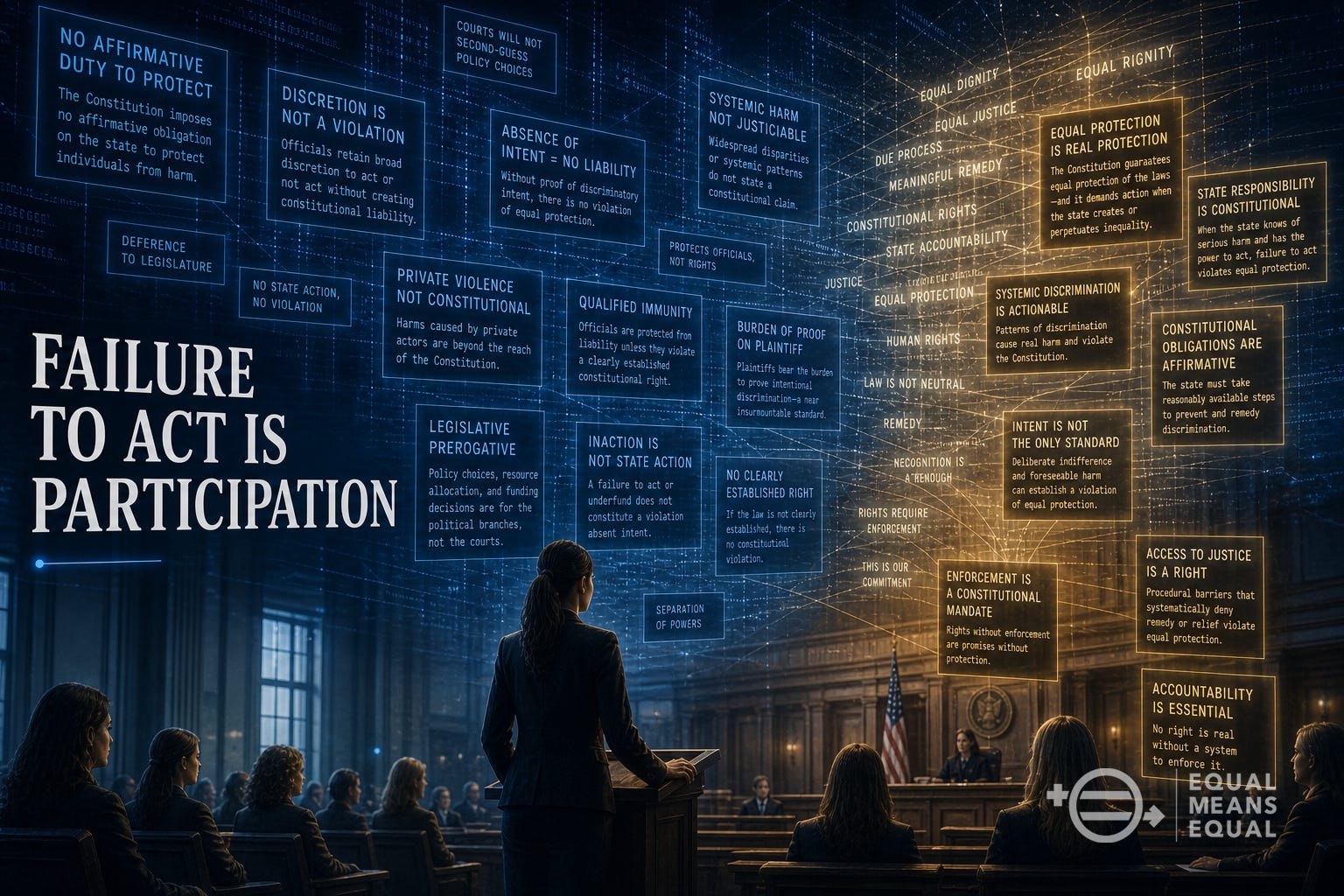
At a certain point, this framework stops describing a limitation of the law and begins to define its function.
Across these cases, the pattern is consistent.
The harm is recognized.
The facts are established.
The consequences are understood.
And yet, no obligation follows.
That is not a neutral outcome.
Once a system can see discrimination and decline to remedy it, the refusal itself becomes part of the structure that allows the harm to continue.
The distinction between action and inaction begins to collapse.
Because the choice not to intervene—when the harm is known, when the consequences are clear, when the pattern has already been established—is no longer passive.
It is a decision.
And that decision has effects.
It determines whether a child is removed from a dangerous home.
It determines whether a restraining order is enforced.
It determines whether violence against women is treated as a civil rights violation or as a private matter.
It determines whether a system built on exclusion continues to shape opportunity.
It determines whether patterns of discrimination are acknowledged and corrected — or simply absorbed.
At that point, the question is no longer whether discrimination exists.
It is whether the Constitution permits a system to recognize that discrimination—and still choose not to act.
Equal protection cannot mean that the law sees inequality and does nothing.
If the Constitution guarantees equality, then the refusal to remedy known discrimination is not outside the system.
It is a violation within it.
What Breaks the Loop
If this is the structure, then the question is not why the system fails to correct itself.
It is why we expect it to.
Nothing in the framework described above creates a mechanism that forces a different outcome once harm is exposed. Recognition does not trigger obligation. Documentation does not compel remedy. Even repeated patterns, across cases and over time, do not alter the underlying rule.
The loop holds because nothing inside the system requires it to break.
Which raises a more difficult question.
What happens when the pattern is no longer treated as a series of isolated cases, but as evidence of the system itself?
Because the cases described here are not disconnected.
They are cumulative.
Each one establishes that harm can be known and left unaddressed. Each one reinforces the boundary between recognition and obligation. Each one confirms that the system can absorb evidence of inequality without changing its behavior.
At some point, that accumulation stops being background.
It becomes the record.
And a record, presented clearly enough and often enough, creates a different kind of pressure.
Not the pressure of a single case, which can be narrowed, distinguished, or dismissed.
But the pressure of a pattern that repeats across jurisdictions, across facts, across plaintiffs—and produces the same outcome every time.
That is where the strategy must shift.
If the system will not recognize inaction as a violation in one case, the answer is not to abandon the claim.
It is to bring it again.
In another jurisdiction.
With another record.
With another plaintiff whose harm cannot be dismissed as hypothetical or remote.
And then again.
Until the distinction between action and inaction—between recognition and obligation—can no longer be maintained without exposing what it is doing.
Why EQUAL MEANS EQUAL v. Trump Matters Now
That confrontation is no longer theoretical.
EQUAL MEANS EQUAL v. Trump is built on the recognition that the pattern described above is not incidental. It is structural.
The case does not ask whether isolated harms occurred.
It asks whether equal protection meaningfully exists in a constitutional system that repeatedly recognizes inequality while refusing to remedy it.
In the case we are now litigating, the federal government is being asked to answer a question it has repeatedly avoided: whether sex-based classification in the structure of military service can continue to exist under a Constitution that promises equal protection.
The case does not arise in isolation. It sits on top of the same framework described here—one in which discrimination can be acknowledged, documented, and left in place.
What is different now is not the existence of the harm.
It is the accumulation of the record.
Because the argument being advanced is not simply that discrimination exists.
It is that the system has repeatedly recognized that discrimination—and failed to remedy it.
And that failure is no longer operating at the margins of the system.
It is coming from the constitutional framework itself.
The Equal Rights Amendment
The ERA changes the burden.
It removes discretion.
It converts equality from recognition into obligation.
The ERA does not ask the government to recognize that inequality exists.
The government has already done that.
Again and again.
In court opinions.
In legislative findings.
In documented patterns of unequal enforcement stretching across decades.
The problem has never been lack of recognition.
The problem has been the absence of a constitutional mandate requiring equality to be enforced.
The Equal Rights Amendment closes that gap.
It removes the ambiguity the system has relied on for decades.
It removes the discretion to acknowledge inequality while leaving it in place.
And it transforms equality from an aspiration into a constitutional obligation.
That is why resistance to the ERA has been so persistent.
Because once equality becomes fully enforceable under the Constitution, the distinction between recognizing harm and remedying it begins to collapse.
With an ERA in place, the system can no longer claim to see inequality while treating enforcement as optional.
EQUAL MEANS EQUAL is funded by individual donors. If you would like to support this work, you can do so here:
https://equalmeansequal.org/donate-to-equal-means-equal
When the judge tells you your argument is correct, but their hands are tied because they have to honor previous injustices, then the system is broken and must be fixed.
I actually had a judge tell me (from the bench) that a restraining order is essentially not worth the paper it's written on. What he said was, if the person who's supposed to be restrained shows up at your door, that he (the Judge) will not be standing there ready to protect you. And here's the quiet part out loud, no matter how fast those cops drive to get there, they are not going to outrun a bullet that is heading your way (that's if they even try to get there as "domestic disturbances" seem to be something that they don't want to get in the middle of). The law has never been fair or equal towards women or people of color, but now that reality seems to be "hitting home" to more people who are being forced to recognize it. Or at least, let's hope so.